




Magazine | Études
Le plus grand colibri du monde est une nouvelle espèce : le Colibri géant du Nord ou Patagon chaski
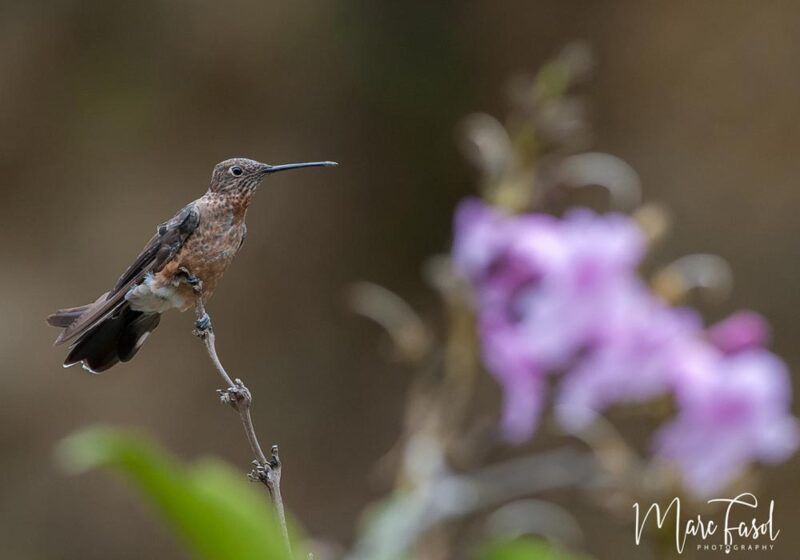
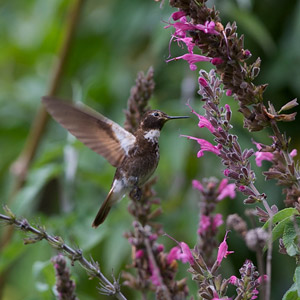
Colibri géant du Nord ou Patagon chaski (Patagona chaski) à Cajamarca, dans le nord du Pérou, en mai 2013. Notez sa gorge cannelle, contrastant avec les stries brunes du dessous, et le cercle oculaire et l’arrière des yeux sont pâles.
Photographie : Marc Fasol / Sa galerie de photos
Introduction
Près de 90 % des 363 espèces de colibris connues vivent à une latitude inférieure à 22° et à moins de 2 000 mètres d’altitude, principalement parce qu’elles se sont spécialisées dans des niches écologiques particulières. Certaines ont toutefois des aires de répartition qui s’étendent au nord du continent américain, comme le Colibri à gorge rubis (Archilochus colubris), qui niche du Canada au golfe du Mexique, ou le Colibri ou Patagon géant (Patagona gigas), qui se reproduit des côtes de l’océan Pacifique aux Andes, où il atteint plus de 4 400 mètres d’altitude. Ce dernier possède d’autres caractéristiques remarquables : il a divergé des autres genres de la famille des Trochilidés il y a près de 14 millions d’années, formant une branche phylogénétique distincte et ses dimensions et son poids (de 17 à 31 grammes) sont nettement supérieurs.
Dans les régions tropicales andines, les Colibris géants résident toute l’année en haute montagne, tandis que les populations tempérées vivant plus au sud se reproduisent dans les plaines côtières et migrent vers le nord pour y passer l’hiver austral.
Dans un article publié en 2024 dans la revue Proceedings of the National Academy of Science (PNAS), des biologistes ont essayé de comprendre comment le Colibri géant pouvait vivre aussi bien dans des régions côtières qu’à de très hautes altitudes en étudiant ses mouvements migratoires et ses capacités respiratoires et en effectuant des analyses génétiques. Ils ont découvert que les populations migratrices effectuaient un trajet aller-retour pouvant atteindre plus de 8 300 km de long pour atteindre le plateau andin central, qu’elles rejoignent par étapes, comme les alpinistes, pour s’habituer au manque d’oxygène, et qu’il existait en fait deux taxons distincts : ils proposent de reconnaître une nouvelle espèce sédentaire montagnarde, qu’ils ont nommée Colibri géant du Nord (Patagona chaski), mais qui pourrait être appelée Patagon chaski en français selon Jimmy Gaudin. C’est désormais le plus grand représentant connu de la famille des Trochilidés. Nous vous proposons une synthèse de leur article.
Abstract
Nearly 90% of the 363 known hummingbird species live below 22° latitude and less than 2,000 meters above sea level, mainly because they have specialized in particular ecological niches. However, some have ranges that extend north of the American continent, such as the Ruby-throated Hummingbird (Archilochus colubris), which nests from Canada to the Gulf of Mexico, or the Giant Hummingbird (Patagona gigas), which breeds from the coasts of the Pacific Ocean to the Andes, where it reaches more than 4,400 meters above sea level. The latter has other remarkable characteristics: it diverged from other genera of the Trochilidae family nearly 14 million years ago, forming a distinct phylogenetic branch and its dimensions and weight (from 17 to 31 grams) are clearly superior.
In tropical Andean regions, Giant Hummingbirds reside year-round in high mountains, while temperate populations living further south breed on the coastal plains and migrate north to spend the austral winter.
In an article published in 2024 in the journal Proceedings of the National Academy of Science (PNAS), biologists tried to understand how the giant hummingbird could live both in coastal regions and at very high altitudes by studying its migratory movements and its respiratory capacities and by carrying out genetic analyses. They discovered that migratory populations made a round trip of up to more than 8,300 km in length to reach the central Andean plateau, which they reached in stages, like mountain climbers, to get used to the lack of oxygen, and that there were in fact two distinct taxa: they proposed to recognize a new sedentary mountain bird species, which they named the Northern Giant Hummingbird (Patagona chaski), and which is now the largest known representative of the Trochilidae family. We offer you a summary of their article.
Poursuivez la lecture de cet article, en vous abonnant dès maintenant !
Découvrez les Archives d’Ornithomedia.com
Pour seulement 10,00 €TTC/an (ou 6,00 € les 6 mois)
Profitez de plusieurs centaines d’articles en accès illimité et sans aucun engagement.
Compléments
Ouvrages recommandés
- Birds of Southern South American and Antarctica de Martin R. de la Pena and Maurice Rumboll
- Birds of Argentina: volumes 1-2 de Mark Pearman
- Birds of Peru de Thomas S. Schulenberg, Douglas F. Stotz, Daniel F. Lane et John P. O’Neil
- Field Guide to the Birds of Machu Picchu and the Cusco Region, Peru: Includes a Bird Finding Guide to the Area de Barry Walker,
Source
Jessie L. Williamson, Ethan F. Gyllenhaal, Selina M. Bauernfeind, Emil Bautista, Matthew J. Baumann, Chauncey R. Gadek, Peter P. Marra, Natalia Ricote, Thomas Valqui, Francisco Bozinovic, Nadia D. Singh et Christopher C. Witt (2024). Extreme elevational migration spurred cryptic speciation in giant hummingbirds. PNAS. Date : 29/03. www.pnas.org
Aucun commentaire sur ce sujet
Participer à la discussion !