




Pratique | Identification
Identification d’un Bécasseau de Bonaparte en Indre-et-Loire en mai 2025 : ce n’est pas qu’une histoire de croupion blanc
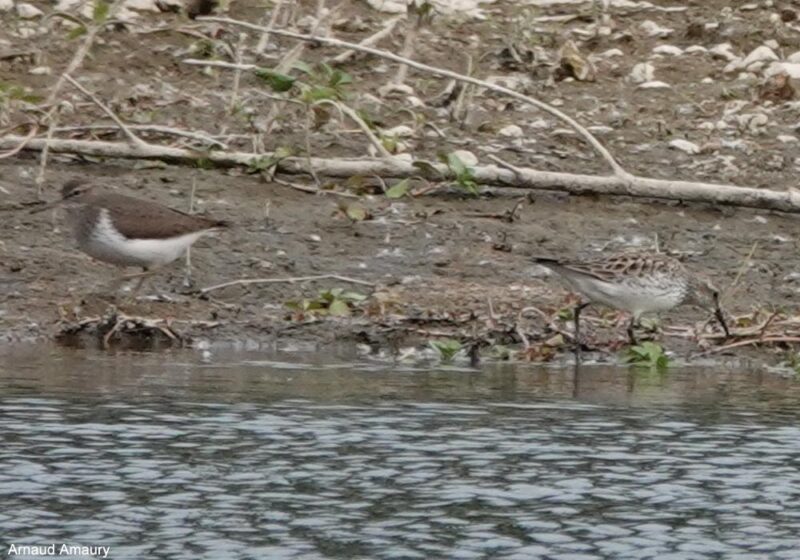
Chevalier guignette (Actitis hypoleucos) à gauche et Bécasseau à croupion blanc ou de Bonaparte (Calidris fuscicollis) le long de la Loire, entre Cangey and Mosnes (Indre-et-Loire), le 8 mai 2025 : notez les flancs et la poitrine striés, les longues ailes et le bec noir légèrement arqué.
Photographie : Arnaud Amaury
Introduction
Les cours moyen et inférieur de la Loire se caractérisent par leurs bancs de sable qui deviennent plus nombreux et plus vastes au printemps et en été, quand le niveau de l’eau baisse. Ils servent de sites de nidification relativement sûrs à plusieurs oiseaux typiques, comme les Sternes pierregarin (Sterna hirundo) et albifrons (Sternula albifrons), l’Œdicnème criard (Burhinus oedicnemus) ou le Petit Gravelot (Charadrius/Thinornis dubius), et des limicoles migrateurs variés y font également halte pour s’y reposer ou s’y nourrir : si leurs effectifs sont moindres qu’au bord de la mer, leur variété est intéressante, et parmi les espèces communes et régulières, des raretés peuvent être trouvées au printemps et en été.
Le 5 mai 2025, un Bécasseau à croupion blanc ou de Bonaparte (Calidris fuscicollis), un échassier nord-américain accidentel en Europe, a ainsi été trouvé par Julien Présent sur l’île sablonneuse des Saugeons, entre Cangey et Mosnes (Indre-et-Loire), où il a été photographié par plusieurs observateurs.
Après une description du Bécasseau à croupion blanc, nous recensons les éléments qui ont servi à identifier l’oiseau de Cangey. Nous remercions Arnaud Amaury, Mathieu Garcia et Benjamin Salvarelli pour leurs clichés et leurs informations.
Abstract
The middle and lower sections of the Loire River are characterized by their sand or gravel banks, which become more numerous and larger in spring and summer, when the water level drops. They serve as relatively safe nesting sites for several typical birds, such as the Common (Sterna hirundo) and Little Terns (Sternula albifrons), the Eurasian Stone-curlew (Burhinus oedicnemus) or the Little Ringed Plover (Charadrius/Thinornis dubius). Various migratory waders also stop there to rest or feed: although their numbers are lower than at the seaside, the variety of species is interesting, and among the common and regular species, rarities can be found in spring and summer.
On May 5, 2025, a White-rumped Sandpiper (Calidris fuscicollis), a North American wading bird that occurs accidentally in Europe, was found by Julien Présent on the sandy island of Saugeons, between the villages of Cangey and Mosnes (Indre-et-Loire), where it was photographed by several birders.
After describing the White-rumped Sandpiper, we list the elements that served to identify the bird found in Cangey. We thank Arnaud Amaury, Mathieu Garcia, and Benjamin Salvarelli for their photographs and information.
Poursuivez la lecture de cet article, en vous abonnant dès maintenant !
Découvrez les Archives d’Ornithomedia.com
Pour seulement 10,00 €TTC/an (ou 6,00 € les 6 mois)
Profitez de plusieurs centaines d’articles en accès illimité et sans aucun engagement.
Compléments
Dans la rubrique Observations d’Ornithomedia.com
Bécasseau de Bonaparte (Calidris fuscicollis)
À visiter sur le Web
Le site web collaboratif www.faune-france.org
Ouvrages recommandés
- Le guide Ornitho Killian Mullarney et al
- The Handbook of Bird Identification: For Europe and the Western Palearctic de Mark Beaman, Steve Madge
- Guide des limicoles d’Europe, d’Asie et d’Amérique du Nord Stephen Message et Don Taylor
- The North American Bird Guide David Sibley
- Kaufman Field Guide to Advanced Birding: Understanding what You See and Hear de Kenn Kaufman
Sources
- Gary Allport (2020). First record of White-rumped Sandpiper Calidris fuscicollis for Mozambique. Bulletin of the African Bird Club. Volume : 27. Numéro : 2. www.researchgate.net
- Colin Rogers and Peter Koch (2018). A second record of White-rumped Sandpiper, Calidris fuscicollis, for South Australia, with some comments on identification. South Australian Ornithologist. Numéro : 43. Pages : 1-2. birdssa.asn.au
- Ding Deep (2015). Waders month by month. digdeep1962.wordpress.com
- Bird Observer. White-rumped Sandpiper (Calidris fusicollis) (WRSA). www.birdobserver.org
Aucun commentaire sur ce sujet
Participer à la discussion !