



Débuter | Pratique
Comment expliquer les différences de proportions d’oiseaux « gauchers » et « droitiers » entre les Becs-croisés des sapins et bifascié ?
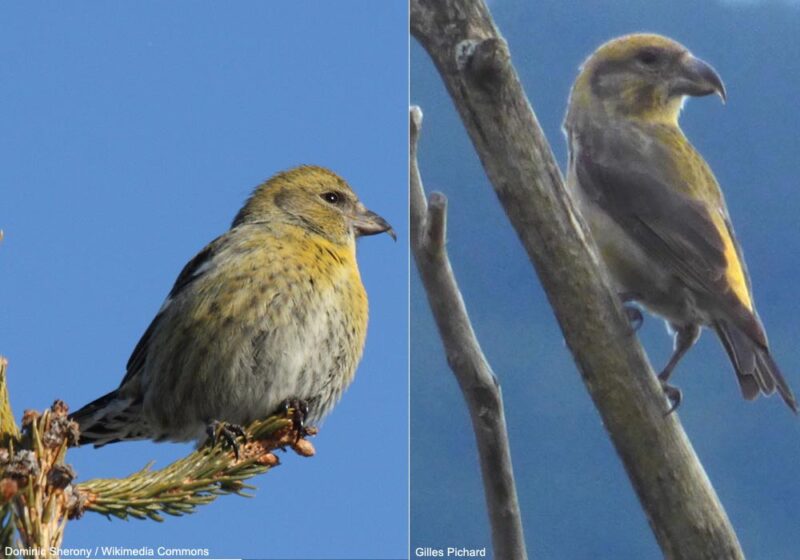
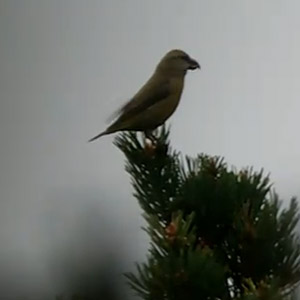
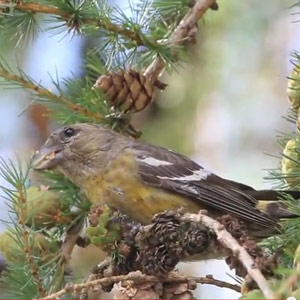
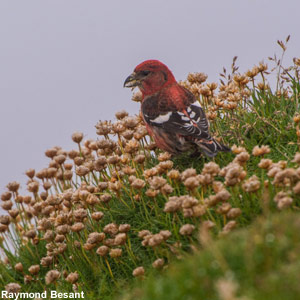
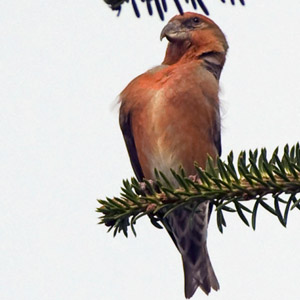
Becs-croisés bifascié (Loxia leucoptera) et des sapins (L. curvirostra) femelles : notez chez la première la mandibule inférieure orientée vers la droite, et vers la gauche chez la seconde.
Photographies : Dominic Sherony / Wikimedia Commons et Gilles Pichard
Introduction
Les becs-croisés sont des passereaux qui ont la particularité remarquable d’avoir un bec dont les deux mandibules se croisent à leur extrémité, une adaptation leur permettant d’extraire les graines des cônes des conifères. Selon les espèces et la taille de leur bec, les essences privilégiées diffèrent : par exemple, à la fin de l’hiver, le Bec-croisé des sapins (Loxia curvirostra) se nourrit principalement des graines de pins, alors que le Bec-croisé bifascié (L. leucoptera) se nourrit principalement de celles des mélèzes.
Le croisement du bec n’apparaît que progressivement chez les oisillons, la forme définitive n’étant acquise qu’au bout de plusieurs semaines. Chez certains individus, la mandibule inférieure est orientée vers la gauche, alors que chez d’autres, le sens est opposé. S’il ne semble pas y avoir de différences en fonction de l’âge ou du sexe, on a remarqué l’existence d’écarts importants entre les Becs-croisés des sapins et bifascié. Alors que chez le premier, la proportion d’oiseaux dont la mandibule inférieure est orientée vers la gauche ou la droite est à peu près égale, près de 75 % des individus de la seconde espèce ont un bec dont la mandibule inférieure pointe vers la droite.
Après une présentation de l’outil remarquable que constitue le bec de ces passereaux spécialisés et une évocation de leur nomadisme alimentaire, nous évoquons les hypothèses avancées pour tenter d’expliquer le fort écart des proportions d’oiseaux « gauchers » et « droitiers » entre les Becs-croisés des sapins et bifascié.
Nous remercions Gilles Pichard pour nous avoir permis d’illustrer cet article et d’avoir soulevé ce sujet passionnant
Abstract
Crossbills are passerines with the remarkable distinction of having a bill with two mandibles that cross at their tips, an adaptation that allows them to extract seeds from conifer cones. The preferred tree species depend on the bird species and the size of their bill: for example, the Red Crossbill (Loxia curvirostra) feeds mainly on the seeds of spruces (Picea sp.) while the White-winged Crossbill (L. leucoptera) prefers those of larches (Larix sp.).
The crossing of the bill only appears gradually in chicks, with the definitive shape only being acquired after several weeks. In some individuals, the lower mandible is oriented to the left, while in others, the direction is opposite. While there do not seem to be any differences in the proportions of « right-billed » or « left-billed » birds based on age or sex, significant differences have been noted depending on the bird species. This has been noted for a long time between the Red and the White-winged Crossbills: while in the former, the proportion of birds with a lower mandible oriented to the left or right is roughly equal, nearly 75% of individuals of the latter species have a beak with a lower mandible pointing to the right.
After a presentation of the remarkable tool that is the bill of these specialized passerines, we discuss the hypotheses put forward to try to explain the large difference in the proportions of « left-billed » and « right-billed » birds between Red and White-winged Crossbills.
We thank Gilles Pichard for allowing us to illustrate this article and for raising this fascinating subject.
Poursuivez la lecture de cet article, en vous abonnant dès maintenant !
Découvrez les Archives d’Ornithomedia.com
Pour seulement 10,00 €TTC/an (ou 6,00 € les 6 mois)
Profitez de plusieurs centaines d’articles en accès illimité et sans aucun engagement.
Compléments
Dans la galerie d’Ornithomedia.com
Dans la rubrique observations d’Ornithomedia.com
Bec-croisé perroquet (Loxia pytyopsittacus)
Ouvrages recommandés
- Le Guide Ornitho de L. Svensson et al
- The Sound Approach to birding, a guide to understanding bird sound de Mark Constantine et The Sound Approach
Sources
- Ron W. Summers, Ben Swallow, Jonas Fridman, Tatu Hokkanen, Ian Newton et Stephen T. Buckland (2024). Irruptions of crossbills Loxia spp. in northern Europe – patterns and correlations with seed production by key and non-key conifers. Ibis. Date : 26/04. onlinelibrary.wiley.com
- Fiona R. Worthy et Philip E. Hulme (2021). Seed Selection by Crossbills Loxia spp. within Cones of Scots Pine Pinus sylvestris. Acta Ornithologica. Volum : 55. Numéro : 2. Pages : 227-242. bioone.org
- Ashley Ahearn (2020). When Does a Crossbill’s Beak Get Twisted? Audubon. www.audubon.org
- David Sibley (2017). Crossbills – Right or Left Billed? Southwestern Idaho Birders Association. www.facebook.com
- Thomas L. Parchman et Craig W. Benkman (2007). Diversifying coevolution between Crossbills and Black Spruce on Newfoundland. Evolution. Volume : 56. Numéro : 8. Pages : 1663-1672. onlinelibrary.wiley.com
- Pim Edelaar, Erik Postma, Peter Knops et Ron Phillips (2005). No Support for a Genetic Basis of Mandible Crossing Direction in Crossbills (Loxia sp.). The Auk. Volume : 122. Numéro : 4. Pages : 1123–1129. Octobre. academic.oup.com
- J. C. Senar, A. Borras, J. et T. Cabrera (1995). The bill crossover ratio of the common crossbill, Loxia curvirostra, is not always 1:1. Ardeola. Volume : 42. pages : 209-210. www.researchgate.net
- Laura Erikson (2005). For the Birds Radio Program: Crossbills. Laura Erikson’s for the Birds. www.lauraerickson.com
- Jefrey G. Groth (1992). Further Information on the Genetics of Bill Crossing in Crossbills. The Auk. Volume : 109. Numéro : 2. Pages : 383-385. www.jstor.org
- John R. Krebs (1991). The case of the curious bill. Nature. Volume : 349. Date : 07/02. www.nature.com
- Caig W. Benkman (1988). Ratio of Mandible Crossing Direction in White-winged Crossbills. The Auk. Volume : 105. sora.unm.edu
- Paul C. James, Thomas W. Barry, Alan R. Smith et Samuel J. Barry (1987). Bill Crossover Ratios in Canadian Crossbills Loxia spp.
Ornis Scandinavica (Scandinavian Journal of Ornithology). Volume : 18. Numéro : 4. Pages : 310-312. www.jstor.org
Aucun commentaire sur ce sujet
Participer à la discussion !