Recherche sur Ornithomedia.com

  Identification
   Livre recommandé

The Raptors of Europe and the Middle East
de Dick Forsman
à partir de 46,15 €
Commander
sur Amazon


  La Buse de Russie ... | English version of the interview of Dick Forsman
 
English version of the interview of Dick Forsman - Updated: 08/12/07

The main criteria to identify a Steppe Buzzard depend often on the age of the bird: juveniles and adults can be very different. As a rule, juveniles never have red tails, nor black trailing edges to wing, nor uniform breast. Even many adults have greyish tails! However, small size (if possible to determine), narrow and pointed wings, white underwing (remiges) with narrow barring and often pale bases to upperwing primaries are good indicators.

Dark morph Steppe Buzzard (Buteo buteo vulpinus)
Dark morph Steppe Buzzard (Buteo buteo vulpinus), Israel: 1) long wings with black trailing edge, 2) rufous tail (with small bars: not fully adult?), 3) white patch on the primaries, 4) uniform breast
Photo: Paul Sterry

1- What are the differences in the silhouette between a Steppe Buzzard and a Common Buzzard? Are the wings and the shape of the head the most important points to look at?

D. Forsman: The wings are slimmer and more pointed in Steppe Buzzard, it being a long-distance migrant, but the difference is not easy to assess, unless you are extremely familiar with thee birds. The wing-shape is not the most important thing at all, but it can be of help if you are used to seeing both types of buzzards. The plumage always has to be the most important in cases like this.¨

2- Is there a difference of size visible in the field?

D. Forsman: In my opinion no! Size is always difficult to judge in the field, especially of flying birds, since there is nothing to compare the size with. The movements of a bird can give some clues as to its size, smaller birds being more agile and quicker on the wing than larger birds.

3- Are there any differences between Common Buzzard and Steppe Buzzard in the way of flying (hovering, …)?

D. Forsman: I doubt there are any constant differences in this respect. Birds adapt to local conditions and hovering occurs in both taxa in the right conditions.

Juvenile Steppe Buzzard  (Buteo buteo vulpinus)
Juvenile Steppe Buzzard (Buteo buteo vulpinus), Israel: 1) white patch on the primaries, 2) striated median coverts, 3) rufous tail, 4) indistinct trailing edge
Photo: Yoav Perlman

4- Is it easy to distinguish an adult Steppe Buzzard from a juvenile Steppe Buzzard?

D. Forsman: Seen well, the answer is yes! Juveniles are streaked below on the body and on the (median) underwing coverts, whereas adults are barred. The trailing edge of the underwing is in adults distinct, broad and black, whereas it in juveniles is browner, narrower and less contrasting. Seen close the iris of adults is dark, in juveniles pale to medium brown, with pupil visible.

Juvenile Steppe Buzzard  (Buteo buteo vulpinus) Juvenile Steppe Buzzard (Buteo buteo vulpinus), Israel: see pale iris
Photo: Dave Trotter
Juvenile Steppe Buzzard  (Buteo buteo vulpinus) Juvenile Steppe Buzzard (Buteo buteo vulpinus) (Buteo buteo vulpinus), Durankulak, Bulgaria, the 30/11/07
1) white patch on the primaries, 2) striated underparts
Photo: Pavel Simeonov / www.branta-tours.com

5- Globally speaking, what are the most important field criteria to distinguish a typical adult Steppe Buzzard from a typical adult Common Buzzard? In particular, are the colour of the tail and the size of carpal patch important to look at?

Intermediate adult Steppe Buzzard (Buteo buteo vulpinus)
Intermediate adult Steppe Buzzard (Buteo buteo vulpinus), Israel: 1) black trailing edge, 2) rufous tail
Photo: Thomas Krumenacker

D. Forsman: All criteria are equally important and you need all of them if you want to separate between these two! Every case has to be judged by itself, because of the huge variation in both taxa. Black morphs and fox-red birds are only found in Steppe, while mostly white birds are only found in some populations of Common. All the others have to be carefully scrutinized. There are Commons with red tails and there are Steppes with brown tails.

Adult Common Buzzard (Buteo buteo buteo)
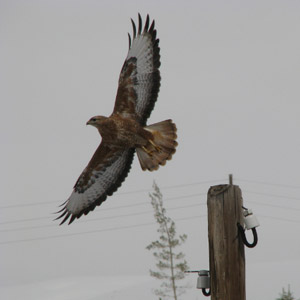
Adult Common Buzzard (Buteo buteo buteo), Switzerland: note short wings, no rufous tint, massive silhouette
1) large black band on tail, 2) pale breast, 3) large black trailing edge, 4) barred vent
Photo: Joël Bruezière

The problem is, that there is a wide overlapping area between these two forms, as one moves from W Europe to the east. A bird may look like a Steppe in plumage, but its measurements may be too big for this form.
The problem is the same as the one we have in Lesser Black-backed Gulls between Larus fuscus intermedius vs. fuscus, where the two forms can be so similar, that nobody is able to put a name to a particular bird, or in Chiffchaffs (Phylloscopus collybita abietinus vs. tristis - read our article: Les Pouillots véloces tristis, abietinus et fulvescens), where you have a series of intermediates (or perhaps a cline?) gradually changing (including the calls) from one form to the other. In the buzzards, the only ones that can be safely identified are the ones featuring a typical plumage AND the correct measurements for either form.
Identifying vagrant individuals away from their normal breeding grounds is, as a rule, NOT possible in the field. We know what the bird looks like, but how can we possibly know where it comes from?

Juvenile Common Buzzard (Buteo buteo buteo) Juvenile Common Buzzard (Buteo buteo buteo), Switzerland: note short and large wings
1) undefined trailing edge, 2) striated breast, 3) striated medium coverts, 4) tail without terminal band, but rufous for this bird!
Photo: Joël Bruezière

6- Is it frequently not possible to distinguish an adult or a juvenile Steppe Buzzard from an adult or juvenile Common Buzzard? How often is it the case?

Adult red-fox Steppe Buzzard (Buteo buteo vulpinus)
Adult red-fox Steppe Buzzard (Buteo buteo vulpinus), Israel: 1) rufous tail, 2) uniform rufous breast, 3) small dark patch, 4) large trailing edge, 5) white area on primaries
Photo: Alain Fossé

D. Forsman: I would say that it is NOT possible in most field situations. Typical individuals in their normal ranges are OK to identify, but vagrants away from home have to be treated with greatest care.
The resident Common Buzzards of W Europe (Britain, France, Gernany) are very broad-winged and heavy-looking, but as soon as migrants from Scandinavia are taken into the picture they are much more similar to vulpinus. And of course, the chance for a migrant to be displaced is always greater than for a resident.

7- 10- Is it easier to distinguish a Steppe Buzzard from a Common Buzzard or a Vulpinus Buzzard from a Long-legged Buzzard?


D. Forsman: Both can be very difficult, it always depends on the individual and the situation in question. I would say that in most cases the size of a (nominate) Long-legged is so huge, that its movements give it away long before one can see the plumage details. This is of course if you are familiar with Steppe Buzzards from before. Also the plumage of most Long-leggeds is diagnostic, but the bird has to be seen well. The North African Long-legged (ssp. cirtensis) is a totally different matter, it being a lot smaller and therefore much more similar to Steppe. In the Common vs. Steppe situation you have the problem of deciding whether the bird is one or the other, or maybe something halfway between the two.

Juvenile Long-legged Buzzard (Buteo rufinus rufinus) Juvenile Long-legged Buzzard (Buteo rufinus rufinus), Bulgaria: long and rectangular wings, like an eagle
1) undefined trailing edge (juvenile), 2) rufous tail, 3) white patches on primaries, 4) net carpal patches
Photo: Pavel Simeonov

Dick Forsman's website

www.dickforsman.com

Others websites

- Branta Tours leaded by Pavel Simeonov (birding trips in Bulgaria): www.branta-tours.com
- Alain Fossé's website: www.digimages.info
- Birding Israel: www.birdingisrael.com
- Thomas Krumenacker's website: www.pbase.com/tkrumenacker
- Joël Bruezière's website: www.eyesonsky.com

To order

The Raptors of Europe and the Middle-East by Dick Forsman


Réagissez à cet article sur notre forum Identification par e-mail (david.bismuth@ornithomedia.com).

 
  Suite de l'article
 
Les Buses de Russie et variable: l'interview de Dick Forsman
English version of the interview of Dick Forsman
  Pratique


   Débuter
   Identification
   Conseils
   Equipement
   Voyages ornitho
   Enfants
   Téléchargement
   Handi-spots

   Livre recommandé
 
Rapaces nicheurs de France : Distribution, effectifs et conservation de Jean-Marc Thiollay (Auteur), Vincent Bretagnolle (Auteur), Ian Newton (Préface)
30,40 €
Commander
sur Amazon

   Voyages nature


   Livre recommandé
 
Photographic Handbook of the Seabirds of the World
de Jim Enticott, David Tipling (Photographies)
207,87 €
Commander
sur Amazon

   Newsletter

   Recevez chaque mois
   notre lettre d'infos
   gratuite.
    Inscription
   
Desinscription


   Livre recommandé
 
Le guide ornitho : Les 848 espèces d'Europe en 4000 dessins de Grant, Mullarney et al.
26,60 €
Commander
sur Amazon


ORNITHOMEDIA (c) 2000 Tous droits réservés