English version of the interview
About
the discovery of the Spectacled Flowerpecker
Reed the full
article "Spectacled
Flowerpecker’: a species new to science discovered in Borneo?".
1- How
do you feel since this famous 18 June 2009?
David P. Edwards: I still can't quite believe our luck
at finding this bird. It seems unbelievable that it would return
over three days and that Richard Webster had such a good camera
to hand. Without this 'luck,' Spectacled flowerpecker would have
gone down as the one that got away!
2- You write that the area is a "dry dipterocarp forest":
but how is it possible that such a forest, with an annual rainfall
mean of 2 669 mm, can be considered as dry?
David P. Edwards: Dry refers to the soil not the rainfall.
There are seasonally flooded dipterocarp forests, which are 'wet.'.
 |
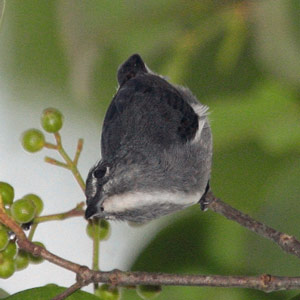
Spectacled
Flowerpecker, probably a female
Photo: R.E. Webster/BirdingAsia |
3- You
watched several species of Flowerpeckers visiting the mistle-toe,
one individual at a time: do Flowerpeckers participate in mixed
flocks in the forest to search for food? Do these flowerpeckers
breed in June?
David P. Edwards: Flowerpeckers are not normal components
in mixed flocks, and they instead forage as solitary individuals
or in pairs. We have caught and observed many juvenile/immature
flowerpeckers in June and July, but I cannot be certain that they
do not breed at other times of the year as well.
4- Do Flowerpeckers eat during all the day, even during
the hottest hours?
David P. Edwards: At both the Borneo Rainforest Lodge (BRL)
and the Danum Valley Field Centre, it is possible to observe flowerpeckers
feeding throughout the day. However, like most birds, flowerpecker
activity peaks in the early morning and the mid to late afternoon
hours.
 |
Situation of the mistletoe (arrow) on which the flowerpeckers
were observed near the Borneo Rainforest Lodge. The tree is
a Koompassaia excelsa
Photo: David P. Edwards/BirdingAsia |
5- Is
this kind epiphyte rare in this forest, as several species have
to share the fruits of the same plant? Do you know if this mistle-toe
species is flowerpeckers pollinated? According a study, is written
that for these kind of specialized pollinisation the fruiting
times often overlappe with the next flowering season and that
the flowers are rather inconspicuous and greenish in color: and
in the R. E. Webster's photos we don't see any flowers near the
fruits?
David P. Edwards: There are several kinds of Mistletoe
in the canopy, and they fruit unpredictably making birds that
use this resource mobile. I am unaware whether flowepeckers play
a role in pollination of mistletoes. You are correct in noting
that on this occasion the mistletoe was only in fruit.
6- The sexual dimophism seems to be low for this species:
is it typical of the Diceaeum species? Do we know why some Floweperckers
have a low sexual dimorphism and others strongly marked differences
between sexes??
David P. Edwards: I do not want to speculate to strongly
about sexual dimorphism in Spectacled flowerpecker since the sexes
are presumed. Until we have a specimen or two, we will not be
able to confirm beyond doubt that this is a species that exhibits
low levels of sexual dimorphism. The Dicaeum has both representatives
that exhibit high levels of dimorphism, and others that totally
lack dimorphism.
 |
Spectacled Flowerpecker, probably a male
Photo: Richard E.Webster / BirdingASIA |
7- Isn't
this kind of striking pattern of the head typical of several bird
species that live in dark tropical forests (for example Picathartes
and Green Bulbuls in African forests)?
David P. Edwards: Yes, there are a number of spectabled,
eye-ringed and wattled representatives in the rainforest understoreys.
Indeed, we settled upon suggesting the common name 'Spectacled
Flowerpecker,' following Spectacled Greenbul (Bernieria zosterops)
of Madagascar.
8- Are the bill structure and the length of the tenth primary
the main characters separating Dicaeum and Prionochilus genus?
Isn't it curious that the length of a feather is one of the main
character of the species of a genus?
David P. Edwards: There may be other characteristics (the
tongue, for example) that are important in distinguishing between
the genera. But the bill (in that it is thin) and primary length
are noted as being particularly important. Of course, in insects
the number of antennal segments can differentiate between genera,
so I suppose a wing feather is in a way similarly obscure
9- You advise to preserve the tongue when a bird will be
eventually collected: why is it important?
David P. Edwards: The tongues of flowerpeckers can be highly
divergent, and from the tongue one can suggest what food types
a particular species specializes on.
 |
Forest
near the Borneo Rainforest Lodge
Photo: David P. Edwards |
10-
You write that it is highly surprising that such a striking bird
could go unnoticed in such a well-watched location as BRL: but
is this bird really striking with a grey plumage? And is it very
surprising that there are still unknown bird species in a such
rich and large tract of lowland tropical forest, with just a few
birders and ornithologist visiting it annually, and only in a
limited part of it (just around the Borneo rainforest lodge)?
David P. Edwards: Perhaps I was a little over dramatic
in terms of how striking the bird is. From my perspective, this
was a very striking species, and certainly of no plumage type
that I had ever seen. Perhaps others would disagree because the
bird is grey!
In terms of whether it is surprising that there are unknown species
in large tracts of forests, I think this comes down to how well
visited places are. Almost all recent avian discoveries have been
made in areas that have not previously been visited (or are very
rarely visited) by scientific expeditions. In contrast, the BRL
and a lot of other areas in Sabahan rainforests are visited frequently
by birdwatchers and scientists, who number in their hundreds per
year. In such places it is evidently important to look towards
the canopy for avian discoveries. Of late, previously overlooked
birds such as Cryptic warbler (Madagascar), Choco vireo (Western
slopes of the Andes in Ecuador and Colombia) and now Spectabled
flowerpecker have all been canopy discoveries of some form.
 |
Canopy
near the Borneo Rainforest Lodge
Photo: David P. Edwards |
11-
Is the protection of the Danum Valley effective? Globally, is
the protection of the forest in the Sabah province efficient,
at least comparatively to the Indonesian part of Borneo?
David P. Edwards: The protection of Danum Valley is effective.
Whilst there have been some regrettable but minor incursions by
loggers, etc., these have not compromised the integrity of this
fantastic forest.
I believe that Malaysian land rights are upheld by law far more
effectively than in Indonesia, enabling effective protection.
The question that remains in both Sabah and Indonesia is what
will happen to the remaining forests that are not included within
protection zones?
12- Why did you visit the Borneo Rainforest Lodge? It is
the best places in the Sabah province to watch birds of lowland
forests?
David P. Edwards: I have been conducting ornithological
studies in the wider area for three years. The BRL offers an access
point to the unlogged forests of the Danum Valley and the logged
forest located nearby.
Is the BRL the best place to watch birds in Sabah? Well, I would
say that the Danum Valley is the best place. Whether birdwatchers
choose the luxury and guiding of BRL or the more rustic charms
of the Danum Valley Field Centre, comes down to personal choice.
But whichever one chooses, this is truly one of the most amazing
places in the world.
13-
What is the best period to watch for birds of the lowland forests
in Borneo? Do you need a recorder + amplifier to attract birds?
David P. Edwards: The drier season from April until September
is best, because you are almost certainly guaranteed dry mornings.
Having access to sounds and playback is a big help in seeing birds.
But before you enter the forest, I would advise trying to learn
the sounds: knowing a bird's song massively increases your chances
of encountering a target species.
14- Do you have any problem with your optical equipment
regarding the humidity? What is your optical and photographic
equipment?
David P. Edwards: I use Swarovski 8 x 32 EL's: They have
never let me down, despite spending 6 months a year in the humid
jungle. I don't carry a camera, and instead focus on sound, which
I love. I use a ME66 Sennheiser microphone and Edirol
R-09HR digital recorder, and these have withstood the rigorous
forests too!
A visiter
- La page de présentation de David P. Edwards sur le site
web de l'Univesrité de Leeds (Grande-Bretagne): http://www.fbs.leeds.ac.uk/staff/profile.php?tag=Edwards_DP
- Le site web de l'Oriental Bird Club: www.orientalbirdclub.org
- Une page consacrée à la Danum Valley Conservation
Area:
www.sensiborneo.com/about-sabah/jungle-wildlife/94-danum-valley.html
- Le site web du Borneo Rainforest Lodge: www.borneorainforestlodge.com
Réagissez
à cet article sur nos forums
ou par e-mail (david.bismuth@ornithomedia.com).
Vous pouvez soutenir
Ornithomedia.com