|
M. Indrawan and P. Verbelen's answers
Mochamad Indrawan's answers
 |
Forests
where lives the Banggai Crow on Peleng Island
Photo:Philippe Verbelen |
Mochamad Indrawan:
My role is as a leader of group of persistent researchers whom establish
the rediscovery in the field (Peleng Island is one of the largest
islands in Banggai archipelago, Sulawesi). Back in 1991, I sent
my colleagues Mr. Yunus Masala and Leffrendy Pesik to the mountain
range in Peleng (I was staying behind on my own, making observations
behind ornithological blinds, studying the near-threatened Sula
Megapode in Labobo island, which is even remoter than Peleng Island).
Yunus and Leffrendy managed to see a small crow in the mist of the
mountains we believed to be the species, but we can not be entirely
sure because we did not have the bird in the hand In 2004, I led
another expedition to the approximate range where the bird was found,
and personally established that the bird survived in fairly healthy
colony (I am intrigued that many people asked me if I have seen
the bird myself, but I am a field ornithologist myself, and I have
seen many of them in the field, even sleep close to their roosting
trees:)
In collaboration with Celebes Bird Club, two specimens were secured,
which were later studied by Pam, me, and others, especially for
taxonomy Between 2004 and present, we conducted conservation measures
for the crow (and other endemic fauna) Special, because since its
description more than a hundred years ago, the Banggai Crow was
never seen in the wild, and in the years prior to our studies feared
to be extinct
The moral of the story is that not to give up on 'lost' species,
to always combine research with conservation measures, and to always
involve local communities where endangered species and human population
share mosaics of forest and agriculture The good news are that we
have trained local community folks, and some birdwatchers have benefitted
of the improved skills of the local people The likely causes of
Banggai Crow's very limited range are dependence on forest habitats,
haphazerd hunting pressure, and possible competition by Corvus
enca I am friends with people who have hunted crows as part
of bushmeat, but it is not done systematically
Some clarifications about Philippe Verbelen's stay on Peleng
 |
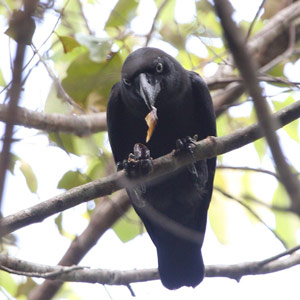
Banggai Crow (Corvus unicolor), Peleng Island, 2009
Photo:Philippe Verbelen |
Philippe
Verbelen: I went to Peleng in April 2009 together with
another birdwatcher, mr Frank Rheindt. This was an independent exploratory
birdwatching during our holidays. In my case, I took a one year
sabathical leave from my job to explore some remote areas (islands
mainly) of Indonesia.
At the time of my visit, Frank and I had already heard about the
rumours that the Banggai Crow had been rediscovered by mr Indrawan
and his team but we did not have precies information how and where
to look exactly for it - so we tried our own luck and decided to
visit Peleng anyway. Once we were there, things went smoother then
expected because, per coincidence, we met some local people who
happened to be the collaborators of mr. Indrawan and his colleagues
at the Celebes Bird Club which greatly facilitated our visit to
the hill forest of West Peleng. Not only were these people knowledgeable
about the areas where we could find the Banggai Crow but they also
had a fairly good general knowledge of the other birds that occur
in these forests. Two Banggai Crows were collected in 2007, and
one bird was photographed in 2009
Did you see one during your stay, and what is the last estimation
of this population?
Philippe Verbelen:
I photographed at least 6 different individuals of the Banggai Crow
and I made numerous sound recordings of their call. My visit to
the hill forest of Peleng (about 10 days) was too short and too
limited in space to formulate an informed idea about population
size.
Why
is this crow so rare? Does it need a specific habitat? Is this habitat
threatened?
Philippe Verbelen: I assume that Mr. Indrawan and his team
are much better placed then myself to answer that question -- considering
the fact that their fieldwork on Peleng islands is long-term and
covered many different areas. Once we reached suitable habitat (hill
forest in a mosaic with slash and burn agriculture and, higher up,
primary looking forest -- we had the impression that the crow was
probably not that rare -- we usually observed several pairs or small
groups of Banggai Crow every day -- depending of course on how much
distance we covered (we did not use transects or other systematic
systems to assess populations). Of course a key question to answer
is how much suitable habitat remains on Peleng -- therefore fieldwork
covering the entire island and perhaps analysis of detailed and
up-to-date satellite images is needed. Perhaps mr. Indrawan and
his team are already involved in doing this, but I am not aware
of this.
 |
Wooded hills where lives the Banggai Crow on Peleng Island
Photo:Philippe Verbelen |
The Banggai crow
clearly seems to be forest depending so deforestation and forest
degradation surely have a negative impact. Deforestation seems to
continue on Peleng island. I have no idea how much hunting is a
real theat for the Banggai Crow's survival today. It probably is
hard to say how rare this crow (currently ranked as "critically
endangered" really is. Previous assumptions that it was (is ?) critically
endangered or sometimes even assumed "extinct" were based on extremely
limited information. How can one assume that a species is extinct
when nobody had been looking in all the possible suitable habitat??
The fact that some ornithologist had previously visited Peleng and
had not seen the Banggai Crow was taken as a good indication that
it had to be rare etc. However, it is very unlikely that these previous
visits ventured far into the hills to reach the right altitude and
hill forest where the Banggai Crow currently occurs. Another confusing
factor is the fact that a second Crow species, the Slender-billed
Crow also occurs on the island. This has raised speculations that
perhaps the Banggai Crow (previously only known from two specimen
collected more then a hundred years ago) was merely a subspecies
of the Slender-billed Crow which is widely distributed in a big
part of the region. It is now however clear that the Banggai Crow
is fairly easy to identify in the field based on a completely different
jizz, a light iris (the info on your website is wrong about this)
and -- most importantly -- a completely different call.
The general assumption is that Slender-billed Crow is a "recent"
colonist of Peleng island. If this is correct, this may be an additional
threat for the Banggai Crow because of competition for habitat etc.
However we also heard many stories that from village elders on Peleng
that suggest that the Slender-billed Crow was already present in
their childhood etc -- so it cannot be excluded that the Slender-billed
Crow has always lived side by side with the Banggai Crow (as is
the case on Sulawesi where Piping Crow and Slender-billed Crow also
occur in roughly the same areas but have different ecological niches.
It is likely however that the Slender-billed Crow has become a lot
more common on Peleng as a result of deforestation and the expansion
of open agricultural areas in the lowlands of Peleng.
We observed Slender-billed Crows commonly in the open disturbed
lowlands and only observed the Banggai Crows at higher altitudes
and in much better forest. Whether or not the Banggai Crow perviously
occurred lower down when the primary forests extended into the lowlands
is a question that mr. Indrawn is better placed to answer. It requires
more fieldwork and interviews with village elders on Peleng who
perhaps know the Banggai Crow from their childhood
Is it common that local populations hunt and eat crows??
Philippe Verbelen:
My visit was too brief to be able to answer this question properly.
Mr. Indrawan and his team have assessed hunting activity as a threat
for the Banggai Crow and that certainly seems plausible. In general,
many of the villagers go hunting for birds and animals in the forest
so I see no reason why they would not hunt a Banggai Crow if they
have the chance. During our visit it is perhaps unlikely that local
people would tell us whether or not they are hunting and eating
the Banggai Crows because the people in the villages where we stayed
knew well that we were birdwatchers and that we were interested
in observing the Banggai Crows. Some people did tell us that they
previously hunted the Banggai Crow but that they have stopped doing
so because they now understand how special (and unique to their
island) the Banggai Crow really is. This is certainly possible and
can be a result of the conservation and education work mr. Indrawan
and his team have initiated since a couple of years now.
Additional activities to raise awareness in the local communities
on the importance to protect the Banggai Crow is necessarry and
could have a positive impact. Local communities need to see that
they can somehow benefit from protecting the Banggai Crow -- perhaps
through small scale ecotourism where the local communities benefit
from some additional income and employment opportunities and projects
that help them to develop agricultural practices that are less destructive
for the forest environment. I understood from mr. Indrawan and his
team that such activities have already started and in the process
of being developed further.
We wish them good luck and hope for the wellbeing of the Banggai
Crow till far into the future!.
Source
MSU News (2009). Long feared extinct, rare bird rediscovered with
MSU scientist’s help. Michigan State University. Date de mise à
jour: 13/10/09. http://news.msu.edu/story/6958/#
Réagissez à cet article sur notre forum Voyages
par e-mail (david.bismuth@ornithomedia.com).
Vous pouvez soutenir
Ornithomedia.com
|
|
 |