Recherche sur Ornithomedia.com

  Magazine
   Livre recommandé

The Field Guide to the Birds of New Zealand
de Hugh Robertson (Auteur), Barrie Heather (Auteur)
28,60 €
Commander
sur Amazon

  L'invitée d'Ornithomedia.com: ... | English version of teh Interview

English version of the interview

Tammy Steeves
Tammy Steeves, School of Biological Sciences (University of Canterbury, New-Zealand)
Photo:University of Canterbury
Presentation of the discovery

Read the media abstract (pdf).

Reference

Part of the questions have been found following the reading of the original study: Tammy E. Steeves, Richard N. Holdaway, Marie L. Hale, Emma McLay, Ian A. W. McAllan, Margaret Christian, Mark E. Hauber, et Michael Bunce (2009). Merging ancient and modern DNA: extinct seabird taxon rediscovered in the North Tasman Sea. Date de mise en ligne: 12 août 2009.
It can be downloaded on the website of the Biology Letters: rsbl.royalsocietypublishing.org.

1- Why did you choose to work on this presumed extinct seabird?

Tammy Steeves: I've been working on boobies for about 10 years now - my previous research suggested that masked boobies in the North Tasman Sea (previously classified Sula dactylatra fullagari) may represent an incipient species - so I was keen to continue working with them when I moved to New Zealand about five years ago. I'd known about the "extinct" Tasman booby (previously classified S. tasmani) for several years and had suspected that S. tasmani and S. d. fullagari may in fact be one in the same taxon but it wasn't until I started speaking with like-minded folks (from across several disciplines here in New Zealand and Australia that I realised it was suspicion that could be tested using a multidisciplinary approach.

2- Why are the mitochondrial control region sequences chosen for DNA analysis?

Tammy Steeves: Because of my previous research - for my PhD I examined patterns of mitochondrial control region sequence variation in a global sample of masked boobies - so it made good sense to compare these data to those in "Tasman boobies".

Right humeri
Caudal view of adult right humeri collected from fossil deposits at Cemetery Bay, Norfolk Island. From left to right: RVST5, RVST4, RVST1, RVST2, RVST3 (juvenile right radius, RVST6, not shown)
Photo: Reproduced with permission from R.N.H
.
3- You sampled 5 modern and 6 fossil specimens, and you wrote "sample sizes were too small for statistical analysis": so how can you conclude about size overlaping between modern and fossil specimens?

Tammy Steeves: Just that - the sizes overlapped.

4- What is the maximum age of a fossil for that you can extract its DNA?

Tammy Steeves: Approximately one hundred thousand years old.

5- Could you explain us simply (if possible!) the functionning and the purposes of the TCS program? In a web site, we can read that it "estimates gene genealogies including multifurcations and/or reticulations": what does it mean? What is a statistical parsimony network?

Figure 1
Figure 1- Statistical parsimony network of Indo-Pacific masked booby mitochondrial control region haplotypes. (Modified with permission from Steeves et al. 2005b.) Circle sizes are proportional to haplotype frequencies. Black circles represent missing haplotypes. Letters A, B and C denote 3 haplotypes (agrandir le schéma)
Crédit: University of Canterbury following Steeves et al. 2005b
Tammy Steeves: Networks, including the statistical parsimony networks generated by TCS, estimate relationships among haplotypes (represented by coloured circles). They are most often used to infer evolutionary history among populations and/or closely related species. Unlike trees, they provide information about sampling location (eg, the three colours used to depict the three island groups - Figure 1) and haplotype frequency (eg, haplotype A was found in 5 individuals from the Kermadecs, 1 individual from Lord Howe, and 1 individual from Norfolk - in other words, haplotype A was shared by birds at all three island groups).

6- You wrote: "we only achieved complete amplification of the mitochondrial control region for one fossile specimen": was it enough for your study?

Tammy Steeves: We also achieved partial amplification (of the most variable, or informative, part of the fragment) in two other samples - combined, these data were sufficient.

7- You wrote "recent genetic evidence suggests S. d. tasmani may be an incipient species": is it really possible to define a subspecies "in process of becoming a true species"? More genreally, what do you think about this trend among biologists to define more and more new species?

Tammy Steeves: The concept of incipient speciation can be somewhat controversial but given what we know about species and speciation in other seabirds, I think it's reasonable to suggest that masked boobies in the North Tasman Sea are indeed in the early stages of a diversification event. I think our study highlights the merits of using a multidisciplinary approach when classifying new species.

Masked booby roosting at Phillip Island
Photo: Reproduced with permission from R.N.H.
8- How do you explain that one of new characters that appeared in the populations of Masked Boobies breeding in North Tasman Sea is a new colour of iris, as it was apprently the case for Thassarche melophris and Thallasarche impavida? And why this same changing of colour from yellow to sepia?

Tammy Steeves: This is an excellent question. And one that I hope to have the answer to within the next few years!

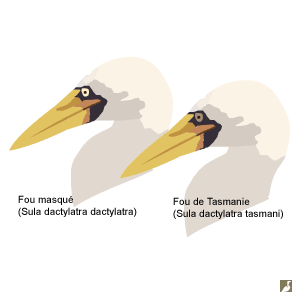
Masked Booby and Tasman Booby
Masked Booby (Sula dactylatra dactylatra) and Tasman Booby (S. d. tasmani)
Scheme: Ornithomedia.com
9- New-Zealand is "rich in extinct birds": are you working on other fossils?

Tammy Steeves: The modern DNA work was performed in my lab at the University of Canterbury (I predominantly work with living species, including masked boobies) - the ancient DNA work was performded in Mike's Bunce's lab at Murdoch University (he predominantly works with extinct species, including moa and Haast's eagle).

10- Beside taxonomy, could you present us the other applications of the integration of ancient DNA data with conventional approaches? The true colours of the plumage of a moa has been recently revealed: would it be soonly the case for its predator, the Haast's Eagle?

Tammy Steeves: Please read the article written by JENNIFER A. LEONARD: "Ancient DNA applications for wildlife conservation" Molecular Ecology (2008): it includes many examples of the utility of ancient DNA. Researchers were able to determine the apparent colour of moa from feathers. Because feathers are currently unavailable for the Haast's Eagle it's rather unlikely.
- it includes many examples of the utility of ancient DNA. Researchers were able to determine the apparent colour of moa from feathers
- because feathers are currently unavailable for the Haast's Eagle it's rather unlikely. DNA sequences from "old" biological samples can be used to answer a variety of questions including: - Evolutionary history of extinct species (e.g. Dodo's and Mammoths)
- Human origins (e.g. Neanderthal DNA)
- Measuring past biodiversity including extinction timing and causes (e.g. Bison)
- Taxonomic resolution (e.g. New Zealand Moa)
- Ancient Pathogen DNA (e.g. 1918 flu and early HIV strains)
- Study of molecular evolution (the use of phylogenetics to understand the tempo and mode of evolution)
- Species Identification (where only bone fragments, coprolites or hair have survived)
- Ecosystem reconstructions (what species used to live there? - what species is best to reintroduce?)
- Midden Analysis (use DNA profiles to determine diet and how it changed over time)
- Environmental reconstructions (using DNA profiles from sediments to determine the composition of past ecosystems)

Contact

tammy.steeves@canterbury.ac.nz


Réagissez à cet article sur nos forums ou par e-mail (david.bismuth@ornithomedia.com).


Vous pouvez soutenir Ornithomedia.com


  Suite de l'article
 
Interview de Tammy Steeves
English version of the interview

  Magazine

   Sommaire
   Livre recommandé

Where to Watch Birds in New Zealand
de Kathy Ombler (Auteur)
15,17 €
Commander
sur Amazon

Publicité


   Livre recommandé

A Photographic Guide to Birds of New Zealand
de Geoff Moon (Auteur)
10,51 €
Commander
sur Amazon

   Newsletter

   Recevez chaque mois
   notre lettre d'infos
   gratuite.
    Inscription
   
Desinscription


   Livre recommandé

Rare Birds of New Zealand
de Geoff Moon (Auteur)
11,63

Commander
sur Amazon
ORNITHOMEDIA (c) 2000 Tous droits réservés