English version of the interview
Presentation
 |
Philip D. Round in action
Photo :
John Willsher |
Philip D. Round is the world's foremost authority on Thailand birds and author of more than 50 papers on their distribution, taxonomy and conservation.
He is the author of Guide to the Birds of Thailand and two other books on Thai birds and wildlife, and has produced a revised checklist of Thai birds. Based at Mahidol University in Bangkok, he has conducted research on birds throughout Thailand as well as in Laos and Vietnam.
Philip Round is also the Regional
Representative of The Wetland Trust.
1- How do you feel after your rediscovery ? Can you sleep now ? :-)
P. D. Round : I've had a long time to ponder the significance of the rediscovery (it is over one year since I caught the bird), so the excitement has now died down. It was very exciting at the time, however, and I do remember that I did have trouble getting to sleep immediately after the rediscovery, though perhaps not for more than one or two nights.
The most difficult thing is that one feels there is always a bit of a hiatus after a discovery of this nature has been published. One must consider " How can I possibly follow this with anything else worthwhile? " It's a purely psychological response that can leave one feeling dispirited and disorientated for a while.
2- Did you really think immediately that it was a Large-billed Reed-Warbler? And why not to an aberrant Clamorous Reed-Warbler?
 |
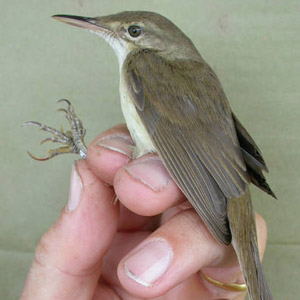
Large-billed Reed-Warbler (Acrocephalus orinus) (Acrocephalus orinus) caught in Thailand in March 2006
Photo : Philip D. Round/The Wetland Trust |
P. D. Round : Realisation was slow in coming. I knew that something was strange, and that it didn't quite fit anything else in my experience (which is why I collected two tail feathers before release.) But I initially resisted identification as Large-billed Reed-Warbler, as catching a bird that had only been recorded one time, so long ago, and no closer than NW India seemed just too unlikely.
But when I had excluded all the other possibilities, this was all that remained, however unlikely it seemed. My colleagues, Peter Kennerley and David Pearson, in UK, both of whom are acknowledged Acrocephalus specialists, who had previously examined the 139 year old type specimen, and to whom I sent photographs and details of my bird, also thought the identification as Acrocephalus orinus (Large-billed Reed Warbler) was the most likely possibility, even before the DNA had been looked at. In fact, Peter Kennerley was the first of us to voice this diagnosis openly.
Clamorous Reed-Warbler could be discounted almost immediately as the wing formula (the relative lengths of the primary feathers, usually a key feature to assist identification of these difficult, birds which have few obvious field marks) was completely wrong for that species.
3- What are the keys identification elements for the Large-billed Reed-warbler, beside the size of the beak? Are the length of the legs, the length of the primary projection and the upperparts color important?
 |
1) short primary projection of the Large-billed Reed-Warbler (Acrocephalus orinus)
Photo : Philip D. Round/The Wetland Trust |
P. D. Round : The most important thing is the very strongly rounded wing, combined with the minute outermost primary (these are elements of the wing-formula, referred to above. Most other warblers that have a rounded wing also show a long outermost primary).
Another feature (first noticed by David Pearson) was that Large-billed Reed-Warbler has a longer hind claw than similar sized members of the genus. (The hind claw in the type specimen and the Laem Phak Bia bird were 7.2 mm and 7.5 mm respectively, compared with average 5.2 mm in Blyth's Reed Warbler).
 |
Large-billed Reed-Warbler (Acrocephalus orinus) :
1) minute outermost primary, 2) longer hind claw than similar sized members of the genus
Photo : Philip D. Round/The Wetland Trust |
NDLR : on the website of the Oriental Bird Club, P. D. Round give also the following features : note the following features: an entirely unstreaked Acrocephalus with warm olive-brown upperparts, slightly paler edges to the greater coverts, tertials and inner secondaries, long large bill with entirely pale (fleshy pink) lower mandible and blackish upper mandible, short whitish supercilium ending at the back of the eye, whitish crescent below the eye, short blackish line behind and before the eye not extending onto the lores, whitish underparts washed with buff on breast, flanks and undertail coverts, short wings (short primary projection approximately one third the length of the visible tertials and six primary tips visible) making the tail appear relatively long, brownish-grey legs.
4- What are the other species of Reed-Warblers that can be caught in the Laem Phak Bia Environmental Research and Development Project?
 |
Head of the Large-billed Reed-Warbler (Acrocephalus orinus) : 1) long large bill with entirely pale (fleshy pink) lower mandible and 2) short whitish supercilium ending at the back of the eye
Photo : Philip D. Round/The Wetland Trust |
P. D. Round : The only other reed warblers caught at Laem Phak Bia are the commonly wintering Black-browed Reed-Warbler Acrocephalus bistrigiceps and Oriental Reed-Warbler A. orientalis (a total of c. 400 of both species now ringed). This is a bit puzzling as two more species, Manchurian RW A. tangorum and Blunt-winged Warbler A. concinens
both occur c. 100 km further down the coast, in a Phragmites reedswamp at Khao Sam Roi Yot. One would have predicted that either of these would be the next Acrocephalus to turn up at Laem Phak Bia.
5- Was the bird singing ?
P. D. Round : No. The bird was never seen in the field. It was taken out of a mist-net, and remained silent during the process of examination in the hand.
6- How was it possible this distinct bird could be confused with Blyth's reed-warblers (Acrocephalus dumetorum) in a museum ?
 |
Above the head of the Large-billed Reed-Warbler (Acrocephalus orinus)
Photo : Philip D. Round/The Wetland Trust |
P. D. Round : I think nobody had looked properly. Until 2002, when a DNA assay of the type specimen was carried out, nobody was even sure that A. orinus was a good species, and not an aberrant example of e.g., Clamorous Reed-Warbler or Blyth's Reed-Warbler, so hardly anybody gave it serious consideration.
The type specimen was in moult and still growing some wing feathers so even the wing formula could not be determined with certainty.
Because the most well-known recent reviewer ( Williamson, 1968) suggested it might be a rare and isolated form of Clamorous Reed Warbler, I doubt anyone looked at Blyth's.
In the Oriental Bird Club's (1996) Annotated Checklist of the Birds of the Oriental Region, it was suggested that the type specimen was referrable to Blyth;s Reed-Warbler. The net effect of this would be to dissuade people from looking for anything different among Blyth's Reed Warblers.
 |
Large-billed Reed-Warbler (Acrocephalus orinus)
Photo : Philip D. Round/The Wetland Trust |
Another Acrocephalus and bird-ringing enthusiast, Stephen Rumsey, Director of The Wetland Trust (who by one of those strange coicidences has supported my work in Thailand since January 2005) has long been fascinated by A. orinus and it was he who encouraged David Pearson and Staffan Bensch to reappraise type specimen.
The results of their findings, which indicated that A. orinus was a good species, were published in Ibis in 2002.
7- Is the genetic analysis on 139 years-old specimen really reliable?
P. D. Round : I am not qualified to comment on this authoritatively as I am not a molecular biologist. However, I think it would be obvious if the DNA was seriously denatured from the kinds of signature it was giving. For more information on this, you ought to ask Prof Staffan Bensch, in whose lab the DNA assay of both A. orinus specimens was done.
8- Why the Large-billed Reed-warbler was so rare and mysterious ? Does it need special ecological conditions ?
P. D. Round : We do not know where the Large-billed Reed-Warbler breeds or normally winters. In fact, we know nothing about its preferred habitat. I presently incline to the view that perhaps one of the reasons it has not been found (aside from its similarity to other, commoner species) is that it occurs in a habitat where nobody looks for reed warblers. It is amost certainly rare, or very patchy in distribution, and has certainly been overlooked. I suspect that now that (especially Indian) ornithologists are better informed as to its appearance, it will not be long before someone finds it (In fact, there were some pictures of a probable A. orinus posted on the Delhibirdpix web-page in April 2007).
9- Do you ring regularly in the Laem Phak Bia Environmental Research and Development Project? Did you discover other remarkable species?
 |
P. D. Round in the netting place in the Laem Phak Bia Environmental Research and Development Project
Photo : Philip D. Round/The Wetland Trust |
P. D. Round : Yes, I have been ringing there regularly since September 2000. It is an extraordinary place, due to the proximity of both salt and freshwater wetland habitats, and well over 200 species of birds have been recorded in the vicinity. I have caught and ringed a few other interesting things, including a taxon of Locustella warbler that is very poorly known (to the extent that we are not entirely sure whether it is a race of Pallas's Grasshopper Warber (L. certhiola), a race of Middendorff's Warbler (L. ochotensis), or possibly even something undescribed. We also have significant numbers of shorebirds wintering nearby, including the globally threatened Nordmann's Greenshank and Spoon-billed Sandpiper.
But the main reason I started working there was to get better data on the seasonality and status of the commoner migrant species, as well as amass more information on the annual cycles of resident birds. (The sedge-beds in which the A. orinus was caught are so rich in insects that they even attract forest-wintering chats and warblers during the migration seasons). This was most unexpected.
Because the site is a pilot project of His Majesty H.M. King Bhumibol Adulyadej, there is a lot of interest in its potential for environmental education and research. Altogether it seemed an ideal site for a bird observatory. The director of the project, Dr. Kasem Chunkao of the College of the Environment, Kasetsart University, Bangkok, and all the Laem Phak Bia project staff have been very supportive and helpful.
10- Could you advice us good others birding spots around the Thailand Gulf?
P. D. Round : The whole of the Inner Gulf shoreline is an amazing place for the sheer numbers of birds it supports- over 0.5 milllion waterbirds, both migrant and resident, use the site.
Undoubtedly the western sectors, especially Phetchaburi, the province in which Laem Phak Bia lies, are the most exciting for birds. This area is much less urbanised and inbdustrialized than parts to the east, and there is still an unbroken transition from freshwater paddy and marsh to brackish water flats and sea. The human population density is also somewhat lower than in sectors closer to Bangkok.
Most of our favourite birding areas are in Ban Laem District of Petchaburi, and they include the area around the KhaoTakhrao temple (Wat Khao Takhrao): an area good for larger waterbirds including Painted Storks and Spot-billed Pelicans; the salt pans at Ban Pak Thale, which support the greatest variety of shorebirds (including up to 16 Spoon-billed Sandpipers and c. 30-40 Nordmann's Greenshank).
Closer to Phetchaburi town around Khao Yoi, the paddies support a few wintering Greater Spotted, Steppe and Imperial Eagles, harriers and Black Kites, and a great many smaller birds including large numbers of Red-throated Pipits.
Relatively close to Bangkok, in Samut Sakhon Province, saltpans, prawn ponds and coastal mudflats at Khok Kham, support a good variety of waders. 1-4 Spoon-billed Sandpipers winter here; a few hundred Asian Dowitchers may be seen on spring passage.
Mangroves and mudflats around the Thachin River Mouth nearby (the site of a Mangove Research Station of the Thai Govt.'s Department of Marine and Coastal Resources) are also very good for birds.
References
- Bensch, S. and Pearson, D. 2002. The large-billed reed warbler revisited. - Ibis
144: 259-267.
- Inskipp, T., N. Lindsey and W. Duckworth. 1996. An Annotated Checklist of the Birds
of the Oriental Region. Oriental Bird Club, Sandy, UK
-
Round, P.D. B. Hansson, D.J. Pearson, P.R. Kennerley and S. Bensch. 2007. Lost and
found: the enigmatic large-billed reed warbler Acrocephalus orinus rediscovered
after 139 years. J. Avian Biol. . 38:133-138.
-
Williamson, K. 1968. Identification for Ringers, Vol. 1. The Genera Cettia,
Locustella, Acrocephalus and Hippolais. B.T.O. Field Guide no. 7, 3rd edn. - BTO.
Tring, UK.
Websites to visit
- One excellent website about the birding spot in the Gulf of Thailand : www.thaiwaterbirds.com
-
Birdlife Thailand : www.bcst.or.th
- Nick Upton's website : www.thaibirding.com
Réagissez
à cet article sur notre forum Identification
par e-mail (david.bismuth@ornithomedia.com).